U.S. Route 250 a Shopping Powerhouse


U.S. 250 a shopping powerhouse


By Tom Jackson
tomjackson@sanduskyregister.com


Jul 05, 2026 8:00 PM

PERKINS TWP. — The area’s U.S. 250 commercial corridor once a road mainly known as the route to Cedar Point, has become a retail and restaurant powerhouse for a five-county region.

That’s emphasized in a new Greater Sandusky Partnership report and by the memories of north Ohio residents who have seen a dramatic transformation of the roadway within their lifetimes.

The new U.S. 250 Retail Corridor Report is a 30-page document put together by Jeff Kerr, planning and policy director for the partnership. It is posted at the local economic development organization and regional chamber’s website, greatersandusky.com.

Data highlights high traffic

Kerr said Erie County is often described as a tourism destination.

While that’s obviously true, don’t forget that U.S. 250 has become a retail hub for a large area and not just in Sandusky, he said.

“We wanted people to understand this is a very healthy retail corridor,” Kerr said.

Kerr’s report uses anonymized cellphone app location data, gleaned from Placer.ai, to track how many customers visited a given business along the U.S. 250 corridor.

That data demonstrates that a 2.1-mile stretch of Milan Road, from Oakland Avenue to Ohio 2, falling within Perkins Township, is a retail magnet that draws people from a five-county region: Erie, Huron, Lorain, Ottawa and Sandusky counties.

The report emphasizes that for a wide local area, the U.S. 250 corridor provides a serious shopping experience for customers who otherwise would have to take a long drive to get to greater Cleveland or to Toledo.

While some customers, of course, live close to the highway, almost one-quarter of all visits come from people who live more than 50 miles away, the report states.

In 2025, the corridor received about 15.6 million overall visits and, of those, nearly 60% traveled 10 miles or more to get to the U.S. 250 corridor.

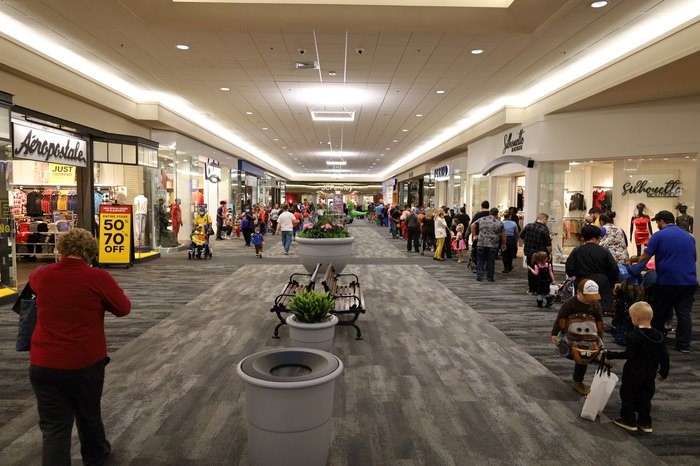
The 2-mile retail corridor includes Sandusky Mall, Walmart, Meijer, Target, Sam’s Club, Menards, Park Place, Crossings of Sandusky that houses the shopping center with Kohl’s and many restaurants that are part of prominent national restaurant chains, the report notes. Two major highways, Ohio 2 and U.S. 250, and local regional highways make the retail corridor accessible to people from cities such as Norwalk, Bellevue, Fremont and Port Clinton, it reports.

In terms of most-visited locations, the study underscores that the:

  • Sandusky Mall was the most visited shopping center.
  • Great Wolf Lodge was the most visited hotel. It did not include areas south of Ohio 2, which includes Kalahari Resorts & Conventions.
  • Raising Cane’s was the most frequented dining establishment. Although the study notes that its methodology might not have recorded customers who were served in fewer than 10 minutes.

Why did it happen here?

The U.S. 250 retail corridor provides better shopping experiences than anyone should really expect in a county that has less than 80,000 people, notes John Hoty, president of Hoty Enterprises, which owns land at a dozen locations along U.S. 250, serving clients such as Starbucks.

Local factors have helped provide a good shopping experience for local residents. It helps that Erie County has Cedar Point and other important tourism and visitor draws, such as the Lake Erie islands and ample boating opportunities, Hoty said.

But a great deal of the credit for the development of U.S. 250 must be given to the Cafaro family, real estate and mall experts based in Youngstown, who made the decision to build the Sandusky Mall in the 1970s.

The Cafaros deserve notice not just for bringing in the mall but for making later decisions that prove they are canny businessmen who know what they are doing, Hoty said.

As the interests of many shoppers have shifted from indoor malls to big stand-alone stores, the Cafaros have brought in stores such as Target, Best Buy and TJMaxx, which is at the mall but also accessible through an exterior entrance. Texas Roadhouse is a hot restaurant tenant, Hoty notes.

Credit for retail development should also go to other players, such as the hotel development spearheaded by the Ruta and Sortino families. But without the mall, the Sandusky area probably doesn’t get stores, like Meijer and Menards, Hoty said. When Meijer came in, it was the Michigan chain’s easternmost outpost, Hoty pointed out.

The Cafaros spotted trends quickly, Hoty said, noting that Sandusky Mall and its nearby tenants have done well even as malls such as Elyria’s mall off of Ohio 57 have failed to prosper.

Mall’s development wasn’t simple

According to “The Sandusky Mall,” a book by Chris Bores, Sandusky officials began talking about bringing a mall to Sandusky in the late 1960s, although at first the idea was to have a mall in downtown Sandusky. A meeting took place in November 1969 to discuss such a mall, but traffic and parking issues showed the proposal wasn’t really feasible, Bores wrote.

William Cafaro, of the Cafaro Co., decided to bring a mall to the Sandusky area. He looked at some possible locations along Ohio 4 before settling on a piece of farmland along U.S. 250.

One thing that made the spot attractive, Bores’ book states, is that there was a four-lane road, U.S. 250, in front of it.

U.S. 250 had been expanded to four lanes around 1970, said Crystal Neelon, a spokeswoman for the Ohio Department of Transportation. It had to be widened because of congestion, Neelon said.

“Back in the day, U.S. 250 was the main route to get to Cedar Point. It is the route we signed for Cedar Point, and, back then, people used guide signs to get to their destinations,” Neelon explained, adding that this was a time before GPS navigation.

Construction of Sandusky Mall began in 1976 with the mall first opening in 1977.

In a book about William Cafaro, his son, Anthony M. “Tony” Cafaro, Sr., recalled that construction of the mall was no easy task.

Hard rock was 2 feet below the surface, as the mall was across the street from a quarry, making it difficult to put in sewer and gas lines. Trucks had to remove raw sewage for the first two years of the mall, while restaurants lacking gas had to use propane tanks. Extensive rock blasting was needed to finally put in the utility lines.

The Cafaros had to work hard to bring in big stores as anchors. Montgomery Ward served as one anchor and so did a JCPenney store, which, according to the Sandusky Library’s history blog, was originally located on Columbus Avenue in downtown Sandusky before it moved.

After a planned third anchor, the May Co., pulled out of its agreement, the Cafaros lured in a local women’s clothing store, Cohn, and subsidized its expansion into a small department store.

It seems possible that U.S. 250 became a big shopping hub simply because it attracted the attention of the Cafaros. William Cafaro (1913-1998) was credited as a real estate pioneer when he died, age 84, at his office in Youngstown. The New York Times obituary said he “was one of the first to see the economic possibilities of shopping centers and strip malls.” He also played a big role in developing Youngstown State University.

William Cafaro’s son, Anthony M. Cafaro, Sr., joined the company full-time in 1969. According to the Cafaro Co.’s website, he built more than 20 million square feet of commercial property in the 1970s and 1980s. A third generation, William A. Cafaro and Anthony Cafaro, Jr., took over in 2009.

Mall spurred further development

Before the mall opened, there was little to lure shoppers or hungry people to U.S. 250.

In a local podcast, The Shore Line, Steven Schuster, the owner of Sandusky Bay Pancake House, formerly Perkins Pancake House, talked about working at his father’s restaurant. It was the only restaurant between Perkins Avenue and Ohio 2 on U.S. 250, Schuster said.

Schuster said the Perkins restaurant opened in 1963 and was then located at U.S. 250 and Bogart Road. In 1966, Schuster’s father acquired the restaurant, so Sandusky Bay Pancake House is celebrating 60 years as a family business this year.

While eateries may have been scarce, aerial photos provided to the Register from the Sandusky Library’s historical archives show that there was some development along U.S. 250 as the mall went in, including a Ramada Inn and Holiday Inn near U.S. 250 and Ohio 2, with a few stores in place or under construction.


Millcreek Mall is going strong at 50-year mark

As shopping centers close nationwide, Millcreek Mall is going strong at 50-year mark

Jim Martin

Erie Times-News


Like many who lived in the Pittsburgh area in the late 1970s, Joe Bell remembers the opening of the Century III Mall in West Mifflin as an event.

“It was a very big deal,” he said of the mall, which once ranked as the nation’s third-largest. “It was a huge mall property. We were wowed just by walking through the place.”

The good times didn’t last. By the late 1990s, Century III faced growing competition and the loss of anchor tenants.

Today, what had been a gleaming showplace is being demolished.

In many ways, the demise of the Century III Mall reflects the declining fortunes of enclosed malls. According to a May report from Capitol One, the number of malls declined an average of 16.7% per year between 2017 and 2022.

The report predicts up to 87% of large shopping malls could close over the coming 10 years.

We need not look far for evidence of that decline. Kmart, the final piece of the Meadville Mall, closed in 2017.

A few weeks ago, demolition began at the Shenango Valley Mall in Mercer County. Owners have plans for a $100 million mixed-used development on the site.

The Millcreek Mall both disrupted and expanded Erie’s retail sector

Fifty years ago, the Millcreek Mall disrupted the status quo in Erie, fueling a retail exodus to the suburbs that was already well underway.

In a 1974 interview, Bernie Gorniak, a spokesman for downtown merchants, saw trouble ahead.

“Somebody is going to get hurt,” he said.

Carlisle’s manager Thomas Pooton wasn’t sure what to expect.

“This is the toughest damned problem we’ve ever handled — trying to figure out what the mall is going to do to Erie,” he said.

Youngstown-based mall developer William Cafaro predicted that the mall would do more than divide the local retail pie into different portions.

He saw that pie getting bigger.

“We’re going to be bringing in great numbers of people who are going to different markets at the present time,” Cafaro said at the time.


Adapting has been the story of the mall in Erie’s backyard

Bell, who has worked for 17 years as spokesman for the Youngstown-based Cafaro Co., owner of the Millcreek Mall, said change has been a constant.

The 2016 loss of Sears, an original anchor tenant, felt for a time like a moment of reckoning. Finding a tenant to fill the 145,000-square-foot space seemed like a tall order.

But it happened and it happened quickly. Less than a year later, Reading-based Boscov’s opened in the former Sears space, now enlarged by 26,000 square feet.

Landing Boscov’s was a highwater mark, but it wasn’t the only time the mall has survived a challenge.

For the mall, whose original anchor tenants included Sears, JC Penney, The Boston Store, Carlisle’s, Halle’s, Kaufmann’s and a Loblaw’s grocery store, the call to adapt has been constant.

It’s why Brian McGrath, who served 24 years as a supervisor in Millcreek Township, doesn’t worry much about the mall’s future.

“The Cafaros have done a very good job of limiting their vacancies. That’s always been the case,” he said. “The names of the stores may change, but they typically get someone to fill a spot if a retailer leaves.”

The names have changed over the years. Of the original six anchors, only JC Penney remains.

The evolution of what was Halle’s, a Cleveland-based department store, reflects the changing face of the mall.

Halle’s, which closed in 1982, was replaced by Dahlkemper’s Catalog Showroom. The space was later home to Burlington Coat Factory, which moved in 2014.

Current occupants of that space, now divided into spaces for six tenants, include Primanti Brothers, Mad Mex, Guitar Center and Round One Entertainment.

Today, the mall complex, which typically ranks among the nation’s 20 largest malls, includes 2.2 million square feet of retail stores, dozens of restaurants and four hotels.


Tax-free shopping on clothes attracts shoppers

In a community that boasts a popular amusement park, one of the country’s top indoor water parks and Pennsylvania’s busiest state park, shopping gives visitors one more thing to do, said John Oliver, CEO of VisitErie, Erie County’s tourism promotion agency.

“It’s also a driver of people coming in,” he said. “We know that tax-free clothes and shoes certainly is an attraction for people in New York, Ohio and other states.”

Canadian tourists — some of whom travel here on two-day and three-day bus tours — come in smaller numbers since the imposition of certain travel restrictions. But they still come, Oliver said.


What’s the secret to success in a changing world?

An unusual accolade for the local mall came in March of 2023 when an online casino ranked it as the best mall in America to seek shelter in a zombie apocalypse.

It was apparently a compliment.

But there is other evidence that speaks to its success.

In 2023, Cafaro reported that the mall logged 12.1 million visitors in 12 months, enough to rank it in the 99th percentile among U.S. shopping centers.

While that total fell to 10.7 million in 2024, Bell described mall traffic as “remarkably consistent for the last few years.”

The challenges facing brick-and-mortar shopping are as well known as the rise of online shopping and what seems like a growing preference for strip plazas.

“The most important element is making sure you are providing the type of businesses a community wants,” Bell said. “Our leasing agents are looking for the right mixture of businesses that are really relevant to the community.”

The definition of relevant has changed since 1975.

Back then, Bell said, malls were built on the foundation of “three or four anchors, seven or so shoes stores and a couple of record stores.”

Shopping remains central to the mission of the mall, which filled a vacant anchor space last year with a new $5.35 million Dicks Sporting Goods, complete with an outdoor athletic field.

“It also means a place for great food and entertainment. People are looking for options to grab drinks, grab dinner or have lunch,” Bell said.

For all that has changed, the Millcreek Mall ranks as a success at a time when the internet is home to a growing list of empty, darkened malls.

Cafaro, owner of 12 enclosed malls and about 40 other properties, has been more successful than most, Bell said.

“I have to say Millcreek is one of the gems,” he said. “It really has done very well for the mall and for other businesses that call it home. We want to make sure we provide something of value to the community.”

Contact Jim Martin at jmartin@timesnews.com.


MINISO: Bringing the Fun


FOR IMMEDIATE RELEASE:

May 14, 2024


Contacts:


Joe Bell                                                                       Margi Valdez

Director of Corporate Communications                      Marketing Director

Cafaro Company                                                      Huntington Mall

jbell@cafarocompany.com                                                 marketingdirector@huntingtonmall.com

330-743-7688                                                              304-733-0492 ext. 102

724-730-4532 (Mobile)


MINISO: Bringing the Fun

“Life is for Fun.” That’s the slogan of a new retailer coming soon to Huntington Mall in Barboursville, West Virginia.  Fun is also the best way to describe the products offered by MINISO.  This rapidly growing retailer will bring its broad selection of housewares and collectibles to a 3,000 square foot space between Journeys and Perfume Villa The store is scheduled to open in mid-summer.

MINISO (pronounced MINI-so) offers lifestyle products such as kitchenware, travel bags, health & beauty products, fashion accessories, small electronics, packaged food items, home storage, bathroom supplies and plush toys. The design flavor is distinctly Asian.  MINISO also features brands such as Sanrio, Disney’s Mickey and Friends, Disney/Pixar’s Toy Story, CN Network’s We Bare Bears and Minions.

MINISO Group is a global lifestyle retailer offering a variety of design-led lifestyle products. Aesthetically pleasing design, quality and affordability are at the core of every product in MINISO’s wide product portfolio, and the company continually and frequently rolls out products with these qualities. Since the opening of its first store in China in 2013, the company has built its flagship brand “MINISO” as a globally recognized retail brand and established a network of over 5,500 stores worldwide.


Huntington Mall has been serving the people of West Virginia, Ohio and Kentucky since 1981. This 1.5 million square foot shopping complex is located off Route 60 and Interstate 64 at exit 20 in Barboursville, WV.  For more information on mall tenants, hours and events, call 304-733-0492 or visit online at www.huntingtonmall.com.  Huntington Mall is owned and managed in association with the Cafaro family of companies, based in Niles, Ohio.  To learn more about the Cafaro organization, go to www.cafarocompany.com.

###